What We Learned at Cloudflare Connect 2026: AI Is Changing How People Find Your Website
Our takeaways from Cloudflare Connect 2026 in San Francisco: more than half of web traffic is now automated, fewer searches send a click, and what small businesses can do to stay findable in AI search.

Last week we were in San Francisco for Cloudflare Connect 2026, held October 19–21 at Moscone West. Cloudflare sits in front of a large share of the web, so it sees how people (and, more and more, machines) reach websites before almost anyone else does. That made it a good place to take the temperature of search.
The opening keynote, The Agentic Internet: Building and securing what comes next, was led by co-founder and CEO Matthew Prince, with guests from Shopify, Mastercard, Oracle and TELUS. The theme carried through the whole event: the web now has a second audience. Alongside the people visiting your site, AI crawlers and AI agents are reading it, summarizing it and, increasingly, acting on it.
Here's what we took away, the numbers behind it, and what it means for a small business website.
More than half of web traffic is no longer human
Cloudflare's own data makes the shift hard to ignore. In The Internet has a second audience, published on September 30, 2026, Cloudflare reported that for the first time, more than half of Internet traffic this year wasn't human.
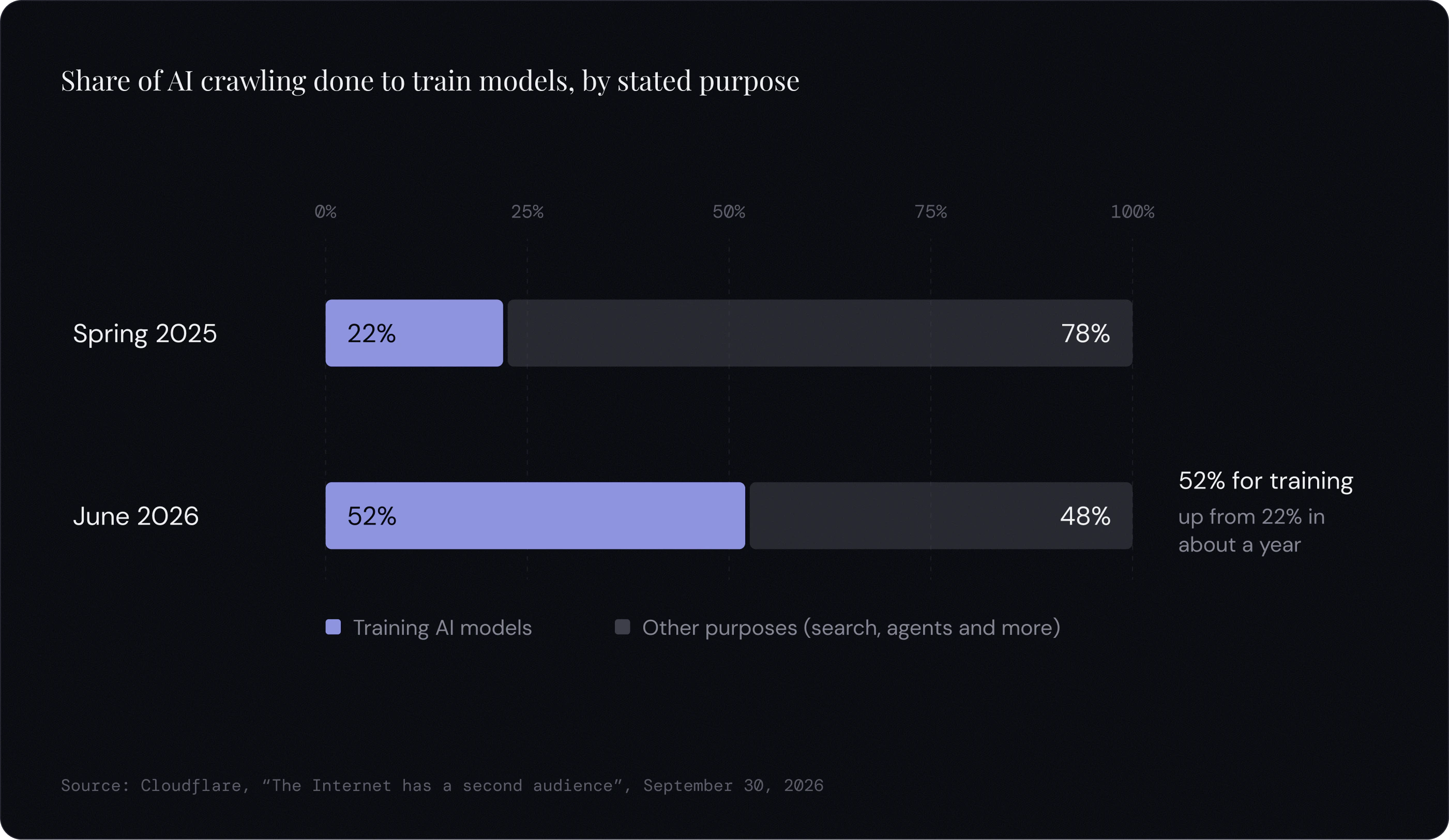
The growth is coming from AI. Daily requests from AI agents grew by more than 1,700% over the past year. And based on what crawlers say they're for, the share of AI crawling done to train models rose from 22% in spring 2025 to 52% by June 2026.
An AI agent is software that browses on someone's behalf: comparing prices, checking opening hours, booking a table. When an agent reads your site, there's no person looking at your homepage. The agent pulls out what it needs and moves on. Your site still has to be fast and well structured, but now it has to be easy for machines to read too. We dig into the numbers in The Agentic Internet: How AI Agents Are Changing the Way People Search.
AI reads more and sends less traffic back
For two decades, the deal with search engines was simple: let them crawl your site, and they send you visitors. AI is breaking that deal.
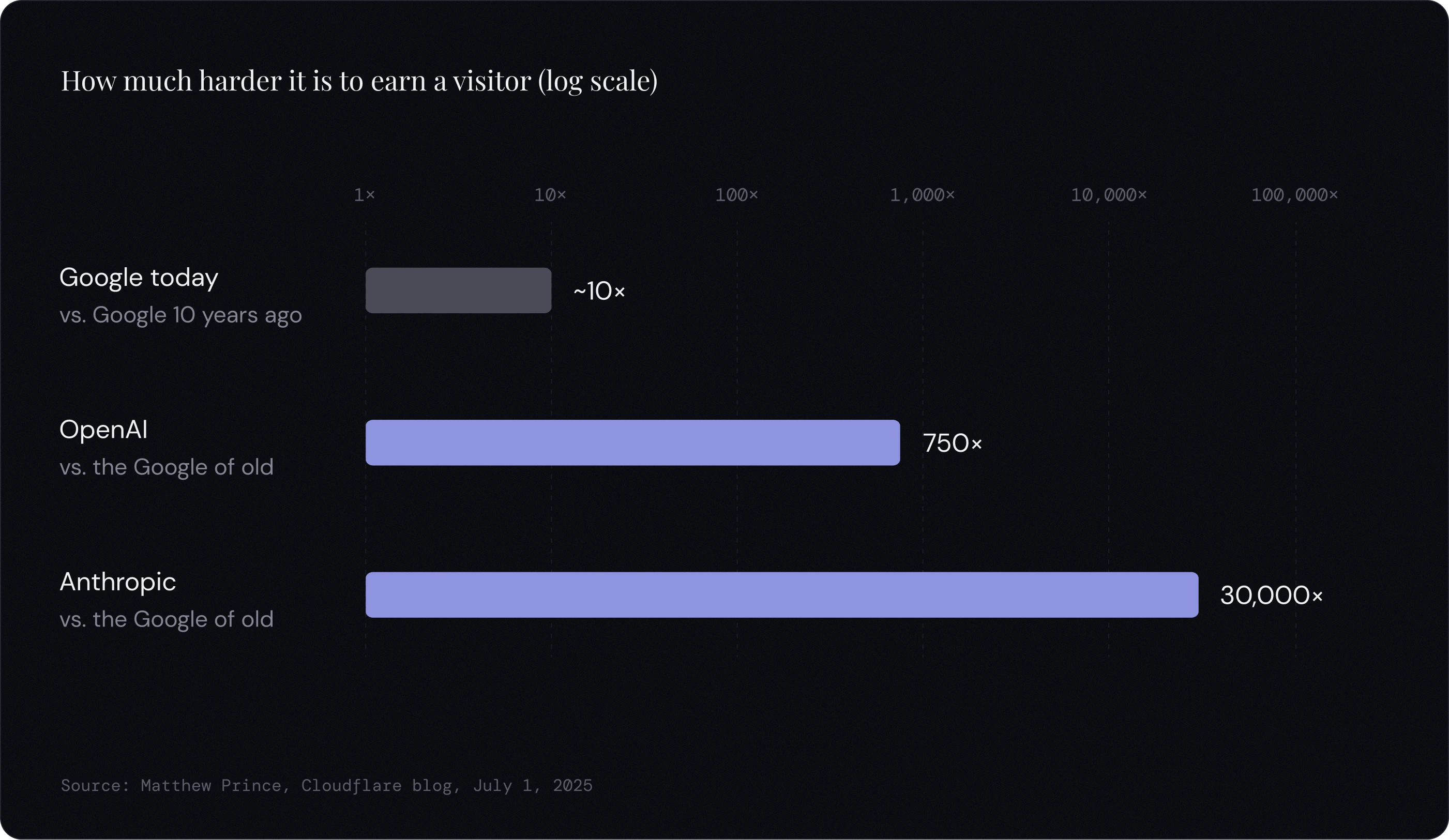
Matthew Prince put numbers on it when Cloudflare began blocking AI crawlers by default on July 1, 2025. He wrote that over the previous ten years it had become almost 10 times more difficult for a content creator to get the same amount of traffic from Google. With OpenAI, he estimated, it was 750 times more difficult than with the Google of old, and with Anthropic, 30,000 times.
Cloudflare's measurements back this up. When it started publishing a "crawl-to-refer" ratio, comparing how many pages an AI platform requests with how many visitors it sends back, Anthropic's Claude made nearly 71,000 page requests for every referral in late June 2025.
Cloudflare has kept tightening the defaults since. Its July 2026 update sorts AI traffic into three categories (Search, Agent and Training) for every customer, including the free plan. Since September 15, 2026, new domains on Cloudflare block Training and Agent bots by default on pages that show ads, while Search bots stay allowed.
What that means for you: your hosting or security settings might be blocking AI search tools from reading your site without you knowing it. If ChatGPT, Perplexity or Claude can't read your pages, they can't recommend you.
Fewer searches end with a click
At the same time, search results increasingly answer the question themselves.
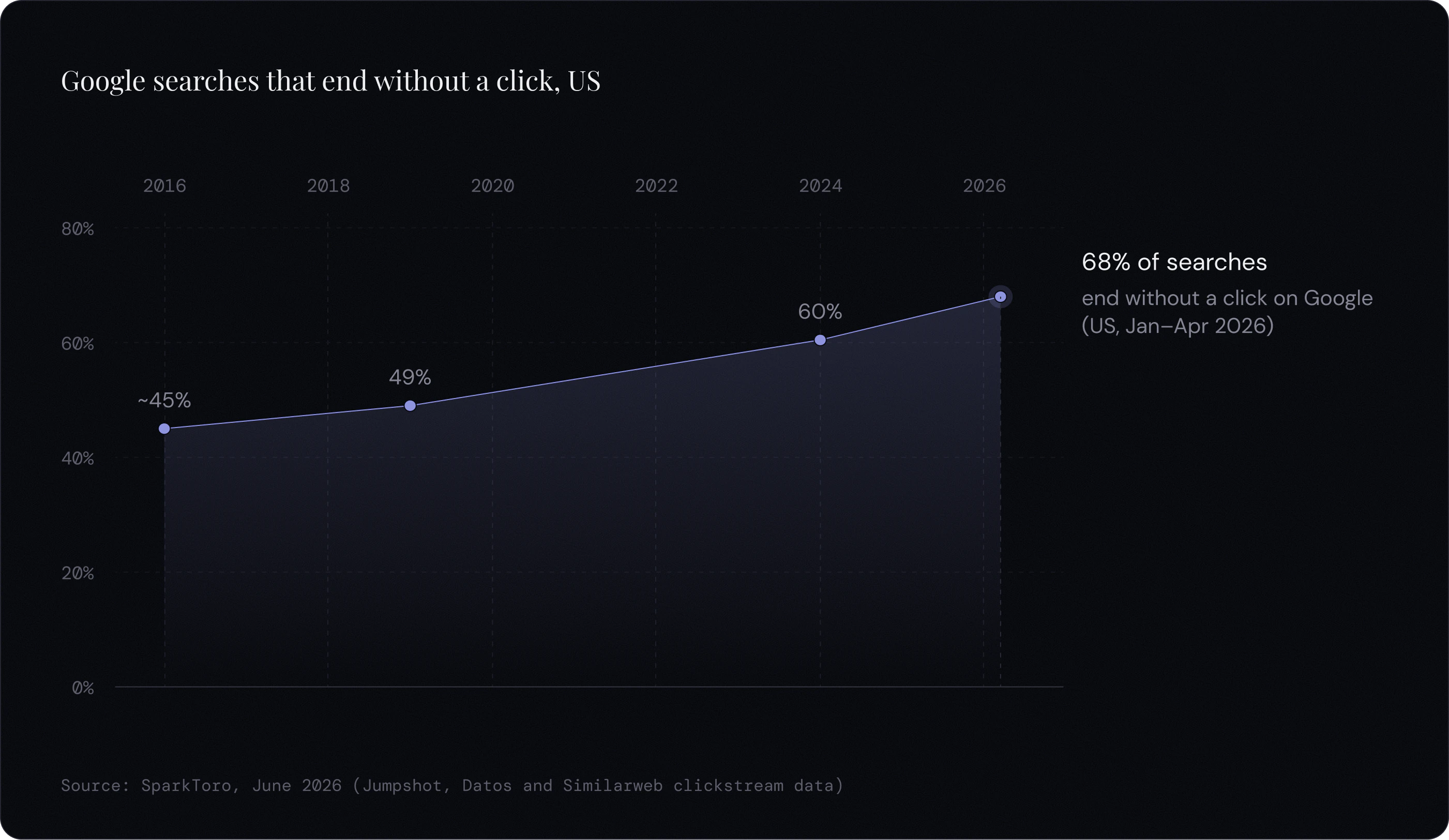
68% of US Google searches ended without a click in the first four months of 2026, up from 60.45% in 2024, according to SparkToro's latest zero-click study. Ten years ago it was around 45%.
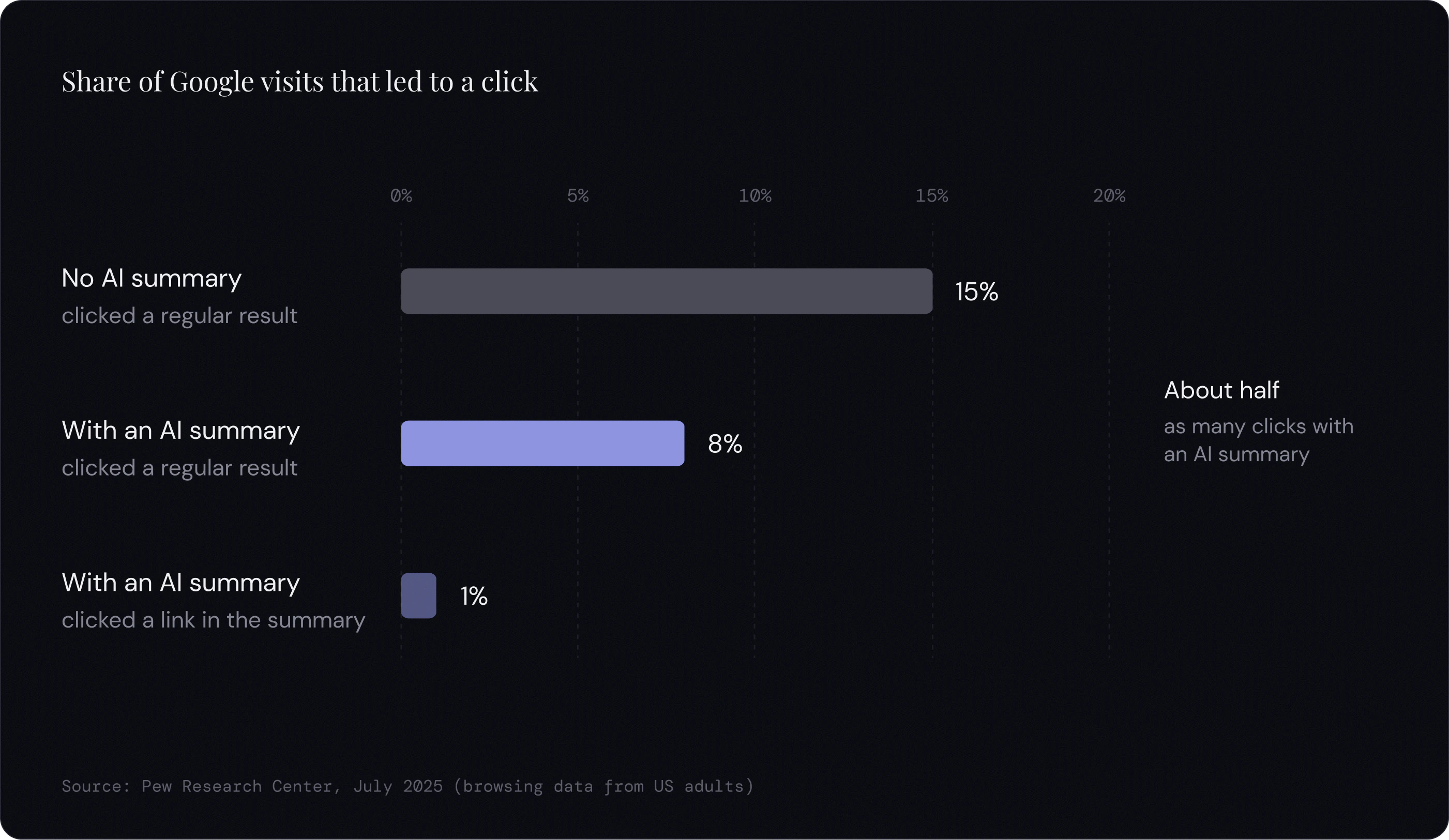
When Google shows an AI summary, people click a regular result in 8% of visits, compared with 15% when there's no summary, according to Pew Research Center. They clicked a link inside the summary itself in just 1% of visits.
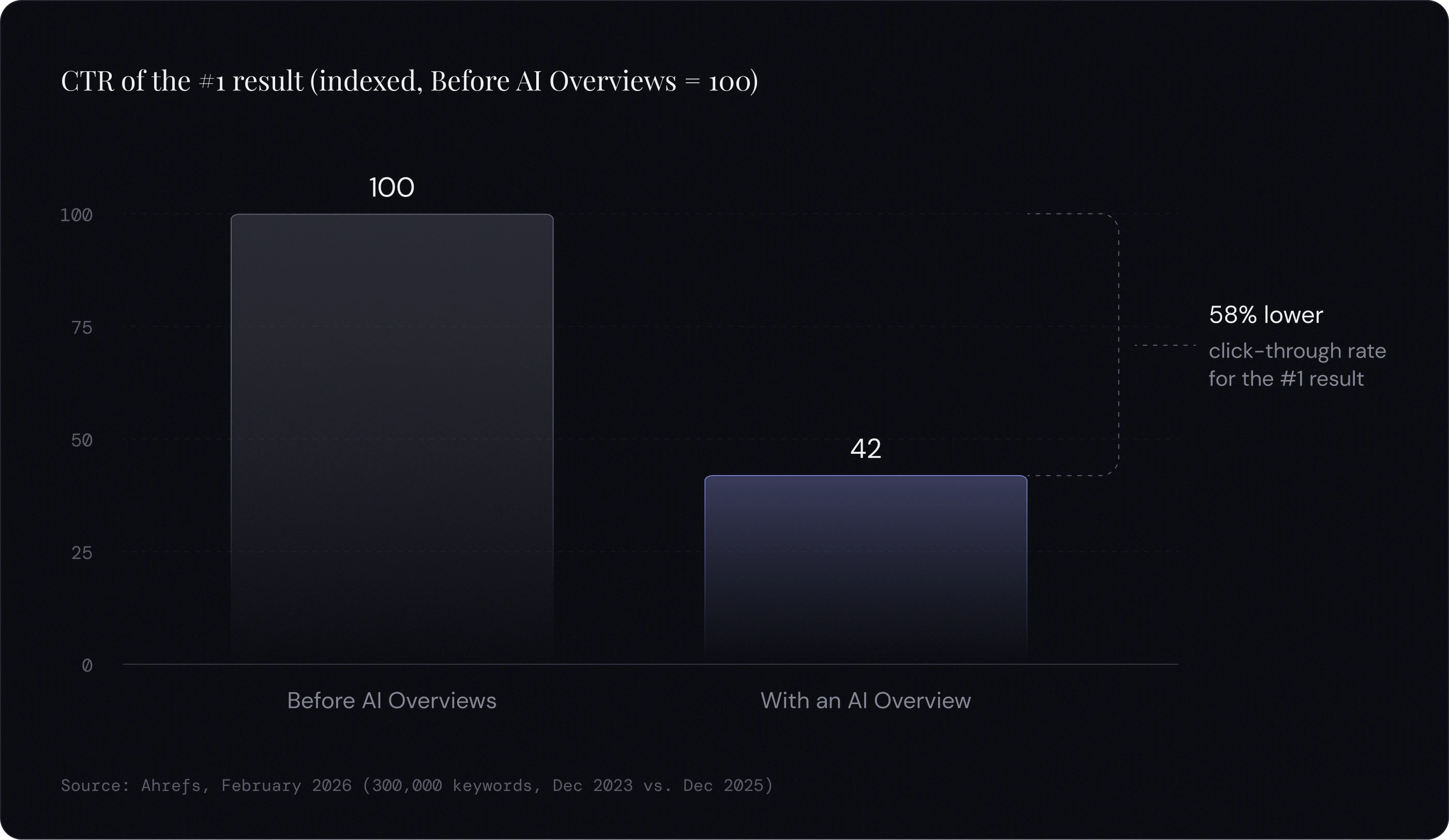
An AI Overview is linked to a 58% lower click-through rate for the top-ranking page, according to Ahrefs' February 2026 study of 300,000 keywords. Its first study, in April 2025, found a 34.5% drop.
Back in February 2024, Gartner predicted that traditional search engine volume would drop 25% by 2026 as people turned to AI chatbots and virtual agents. Whatever the exact figure turns out to be, the direction is clear.
Search isn't dying. It's moving.
None of this means people have stopped searching. They're searching in more places. In its Q2 2026 earnings remarks, Google said AI Mode has passed 1 billion monthly users, the Gemini app has 950 million, and Google is "sending billions of clicks to websites every week through AI features in Search."
So the clicks still exist. There are just fewer of them per search, and they go to the sources AI tools trust and can read. When an AI answer names three local web designers, three plumbers or three cafés, you want to be one of them.
What this means for small businesses
You don't need to rebuild your marketing around AI. But a few basics matter more than ever:
- Make sure AI tools can read your site. Check your robots.txt and your hosting or CDN settings to see which AI search crawlers you allow. Blocking AI training is a reasonable choice; blocking AI search by accident is costly.
- Keep your site fast. Fast pages are easier for crawlers and agents to fetch, and better for the people who do click through. Google's Core Web Vitals are still the yardstick.
- Answer questions plainly. Clear headings, real answers near the top of the page, and accurate details (services, prices, hours, location) give AI tools something to quote.
- Get the search basics right. Page titles, meta descriptions, structured data and a sitemap still decide whether you're found at all, by Google and by AI.
- Earn mentions on credible sites. AI tools lean on sources they trust. Local directories, reviews, partners and press all add up.
- Track what matters. Watch calls, form fills and bookings, not just traffic. A visitor who arrives after an AI recommendation is often closer to buying.
How WebTempo can help
This is the work we do every day for small businesses in Minneapolis, St. Paul and across the Twin Cities. We build fast, modern websites and handle the SEO that keeps you visible on Google and in AI search.
To see where your site stands right now, run our free website audit. In about a minute it checks:
- Your speed on phones and computers, using Google's own test
- Your search basics, like titles, descriptions and secure HTTPS
- Whether AI tools such as ChatGPT, Perplexity and Claude can read your site
- What to fix first, in plain English, with a PDF report you can share
If you'd rather talk it through, get in touch. We'll tell you what we'd fix first, for free.
Sources
- Cloudflare: Cloudflare Connect 2026
- Cloudflare Blog: The Internet has a second audience (September 30, 2026)
- Cloudflare Blog: Content Independence Day: no AI crawl without compensation!, Matthew Prince (July 1, 2025)
- Cloudflare Blog: The crawl before the fall… of referrals: understanding AI's impact on content providers (July 1, 2025)
- Cloudflare Blog: Your site, your rules: new AI traffic options for all customers (July 1, 2026)
- SparkToro: In 2026, Less than One Third of Google Searches Still Send a Click, Rand Fishkin (June 8, 2026)
- Pew Research Center: Google users are less likely to click on links when an AI summary appears in the results (July 22, 2025)
- Ahrefs: Update: AI Overviews Reduce Clicks by 58%, Ryan Law (February 4, 2026)
- Gartner: Gartner predicts search engine volume will drop 25% by 2026 due to AI chatbots and other virtual agents (February 19, 2024)
- Google: Alphabet Q2 2026 earnings remarks (July 22, 2026)